
Polk County Scheduled Versus Actual Release
A scheduled or anticipated date is a current calculation. An actual release date records when one custodian ended custody. Those facts can differ. A pretrial NWRCC detainee usually has no fixed sentence-based date because release may depend on a court ruling, bond, dismissal, plea, or another hold. A sentenced local detainee may have a calculation based on the court order and jail credit. A person committed to MNDOC can have the exact public field Anticipated Release Date.
Release must also be tied to a custodian. Leaving Northwest Regional Corrections Center can mean community release, transfer to MNDOC, another jail, federal custody, or ICE. Leaving prison confinement can begin supervised release while DOC jurisdiction continues. Final discharge is a later event. These distinctions prevent a future date from being read as proof that all custody and supervision will end that day.
- Anticipated release
- MNDOC's exact label for the current future prison-release calculation.
- Actual release
- The recorded event when a named custodian ends custody.
- Supervised release
- The community portion of a covered executed Minnesota sentence.
- Detainer
- A request or hold that can lead to transfer or continued custody.
Find a Polk County Projected Date
Begin by identifying the person’s current legal custodian. The Northwest Regional Corrections Center roster is only a weekday current-custody snapshot and does not publish projected release dates. The MNDOC Public Viewer is appropriate only for adults committed to the Commissioner of Corrections who remain under DOC jurisdiction. A local jail stay by itself does not put a person in that statewide locator.
- Confirm whether the person is at NWRCC, in MNDOC custody, in another jurisdiction, or awaiting a court decision.
- For MNDOC, search by the full six-digit offender ID when known or use a prefix-based name search.
- Match birth date, aliases, status, offense, and court file before relying on the detail.
- Read the field exactly as displayed. For an incarcerated detail, use “Anticipated Release Date.”
- For an NWRCC sentence, read the Polk court sentence and ask TCCC for the facility calculation or liberation record.
- Check holds, later orders, discipline, and the receiving system before treating the date as final.
The official MNDOC search screen shows the entry route for a state commitment.
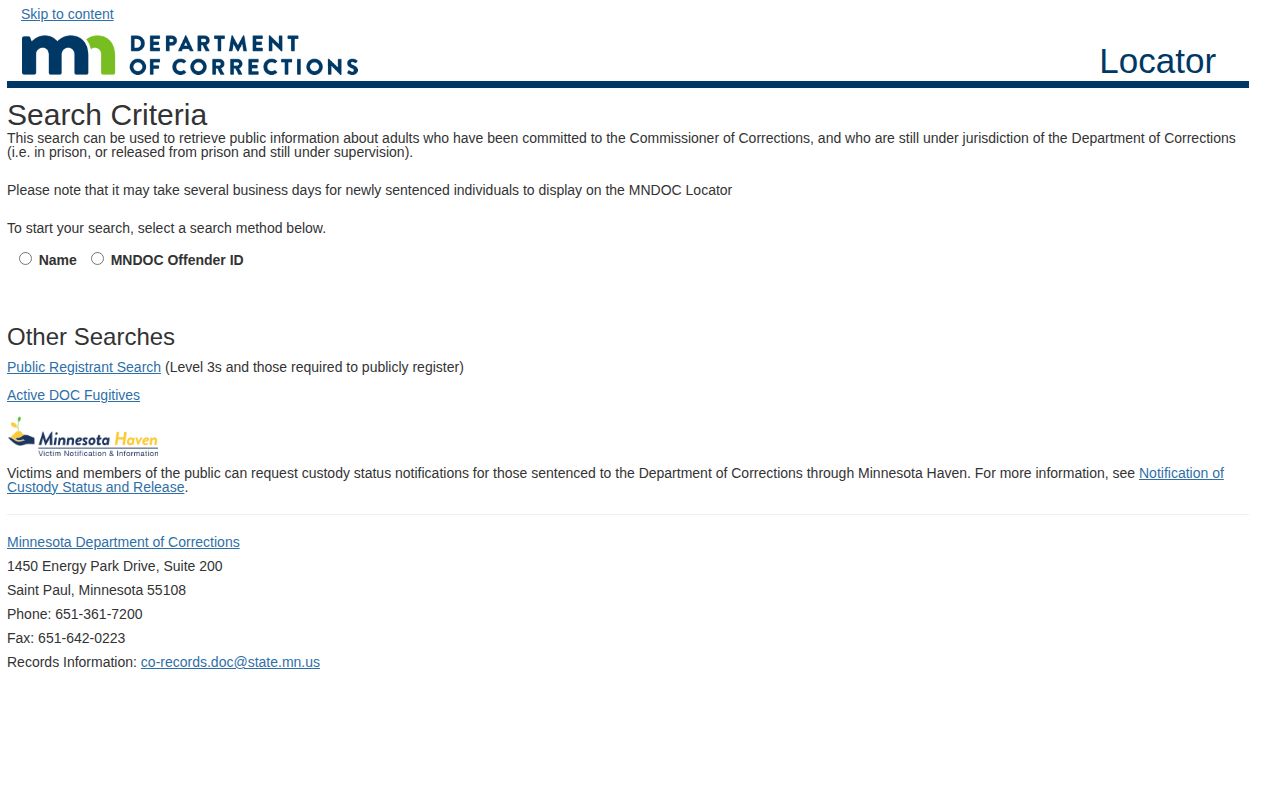
The result list and detail must be matched carefully because the portal can return names, prior names, and aliases.
Polk County MNDOC Date Fields
The Public Viewer’s results columns are Name, Birth Date, Also Known As Name, MNDOC Offender ID, and Current Status. An individual detail can add the official DOC name, aliases, status and effective date, current facility or supervising agency, sentence date, Anticipated Release Date for an incarcerated record, expiration date, caseworker or agent, highest-ranked offense, and court file numbers.
| Public field | How to read it |
|---|---|
| Current Status | Whether DOC reports prison custody, supervision, or another active status. |
| Anticipated Release Date | The current projected prison-exit date for an incarcerated record. |
| Status effective date | When the displayed status took effect. |
| Current facility or agency | The place of confinement or supervising office. |
| Expiration date | A jurisdiction or supervision endpoint, not necessarily the prison exit date. |
| Court file number | The link back to the sentence and later court orders. |
An observed supervised detail displayed “Under Supervision as of” a date, the agency, expiration date, and agent, but no past actual-release field. That combination strongly indicates that prison confinement ended and DOC supervision remains. It does not replace an official record of the actual release event.
Note: Newly sentenced people may take several business days to appear, so a recent NWRCC transfer may not yet return a DOC result.
Polk County Prison Release Formula
For most covered fixed executed felony sentences for offenses committed after August 1, 1993, Minn. Stat. § 244.101 begins with two-thirds imprisonment and one-third supervised release. Minnesota should not be described as an 85-percent state. The two parts together make the executed sentence. Discipline can extend confinement and reduce the supervised-release time that remains.
The Minnesota Rehabilitation and Reinvestment Act can alter that calculation for eligible participants. Section 244.44 allows earned incentive release credit of up to 17 percent of the total executed sentence, subtracted from imprisonment. The credit cannot reduce imprisonment below one-half of the executed sentence, does not lengthen the statutory supervised-release term, and can be revoked for rule violations or criminal acts.
Eligibility is not universal. Section 244.45 excludes life sentences, pre-May 1, 1980 indeterminate sentences, and people governed by the old good-time system. Other provisions govern an individual rehabilitation plan and eligibility. A rough fraction cannot show whether a particular person qualifies or has earned credit.
Life and older indeterminate sentences require a different reading. The Minnesota Supervised Release Board handles the limited matters within its statutory authority, not every routine determinate sentence. A board schedule or review date is not itself a release date. The individual decision may grant release, deny it, set future review, or later be rescinded because of a pre-release violation. Use the written decision and current DOC detail together.
Sentence fractions also do not account for every court-file fact. Jail credit may reduce time left to serve. A corrected warrant of commitment or resentencing order may change the calculation. The highest-ranked offense shown by MNDOC is useful for identification, but the full sentence and all court files control more than a short public label can convey.
When Polk County Release Dates Shift
Minnesota adds a calendar rule that makes home arithmetic especially risky. Under Minn. Stat. § 244.05, subd. 1a, a scheduled release for a covered crime committed on or after August 1, 1992 that falls on Friday, Saturday, Sunday, or a legal holiday moves to the first later day that is not Friday, a weekend, or a holiday. For earlier covered crimes, the statute directs release to a preceding qualifying day.
This adjustment can shift a computed date by several days even before prison credit, discipline, or a court correction is considered. It is a state-prison rule for covered cases, not proof of a local NWRCC policy. The jail’s own public materials did not provide a Polk County good-time formula or a standard weekend-release method.
| Factor | Possible effect |
|---|---|
| Court correction or resentencing | Changes the controlling term or credit. |
| Jail or prison credit | Changes time remaining on the term. |
| Disciplinary confinement | Can delay prison exit and reduce later supervision time. |
| Earned incentive credit | Can reduce imprisonment for an eligible participant. |
| Statutory exclusion | Prevents use of a credit framework in covered cases. |
| Weekend or holiday rule | Moves the scheduled release to a qualifying day. |
| Detainer or hold | Can cause transfer instead of community release. |
Polk County Jail Sentence Dates
A county-jail sentence must not be calculated with the DOC felony formula. No official public NWRCC good-time policy was found. Use the sentencing order, the facility’s calculation, and the permanent jail record instead. The Polk County court record can show sentence length, jail credit, a stayed sentence, probation, a later order, or a report date. NWRCC records the actual admission and liberation.
The NWRCC FAQ says the jail cannot change a court-ordered report date or time. An extension must go through counsel and the sentencing judge. The facility also advises confirming through the Polk County District Court route because the jail may not yet have the paperwork and cannot accept a person without legal authority. The court controls the order; the jail controls its own admission and release record.
If the person remains on a dated NWRCC roster, that establishes only reported custody as of the roster’s weekday update. If the name disappears, use the TCCC data-practices route to ask when and by what authority the person was liberated and for a destination if maintained. The result may be community release or transfer.
A local release can also depend on a bond or new court order rather than the completion of a term. That event cannot be forecast from the DOC two-thirds formula. Likewise, another jurisdiction's hold can cause immediate transfer when the local authority ends. Ask for the disposition or destination if maintained, then verify the receiving system.
Do not substitute a court report date for a release date. A report date tells a person when to begin a sentence or surrender under an order. NWRCC says it cannot alter that date and may be unable to accept the person until it has legal paperwork. Admission begins the jail record; later liberation ends that named jail episode.
Confirm Polk County Actual Release
A future date should be checked again close to the event. For state prison, revisit the MNDOC detail and note changes in status, date, facility, or supervising agency. Minnesota Haven is the DOC notification system. For local jail custody, Minnesota VINE can send a facility-fed release or transfer alert. The Polk County VINELink check explains the local registration path.
Use the record that matches the question. A court order shows legal authority and sentence changes. The § 641.05 jail record shows when and by what authority NWRCC liberated a person. A DOC record establishes its own custody and supervision status. BOP and ICE maintain separate systems. No single no-result proves freedom, full discharge, identity, or present location. The Polk County released-inmate search maps those custody-specific records when the current system is unclear.
For a Polk County court sentence, preserve the case number and the version of the order used in the calculation. For an MNDOC date, preserve the offender ID and the date on which the public detail was checked. Those anchors make it easier to resolve a later change without confusing a namesake, a prior booking, or an old estimate with the current calculation. Also record the named facility or supervising agency because a transfer or status change can alter which office holds the next authoritative date.
When dates conflict, use the offender ID or booking number, compare the court file, and ask the responsible agency for its record. State prison exit, local jail release, transfer, supervised release, probation, and final discharge are separate events. The strongest answer names the event, date, custodian, legal authority, and source date without claiming more than the official record establishes.