
Polk County Parole Versus Probation
Minnesota terms carry distinct legal meanings. Probation is ordered by a court. It can follow a stayed sentence or a local jail term and does not require a prior state-prison term. Supervised release generally follows the imprisonment part of a covered executed felony sentence. Traditional parole is now most relevant to life sentences, old indeterminate sentences, and the limited cases reviewed by the Minnesota Supervised Release Board. A person on any of these forms of supervision may live in the community.
| Status | Who sets it | Public starting point |
|---|---|---|
| Probation | Sentencing court | Polk court sentence and TCCC office |
| Supervised release | Minnesota law and MNDOC | MNDOC Public Viewer |
| Parole | Supervised Release Board in covered cases | Board materials and DOC record |
| Discharge | Court or corrections authority | Final order or agency record |
- Probation
- Court-ordered community supervision, often tied to a stayed sentence.
- Supervised release
- The community portion of a Minnesota executed prison sentence.
- Parole
- Discretionary release used in the limited cases within board authority.
- Discharge
- The end of supervision or agency jurisdiction shown by the controlling record.
Verify Polk County Post-Release Supervision
No public TCCC client-name search was found. The verification path therefore depends on whether the person has a DOC commitment or a probation-only Polk case. The MNDOC Public Viewer is the first stop for an adult who remains under DOC jurisdiction. A supervised detail can display “Under Supervision as of” a stated date, the current agency, expiration date, and agent. A county-jail-only record may never appear there.
- Use the six-digit MNDOC Offender ID when known; otherwise search name variants.
- Match date of birth, aliases, court information, and offense details before choosing a record.
- Read Current Status and its effective date, then note the current supervising agency, expiration date, and agent if shown.
- If TCCC appears, contact the correct Polk-area office and ask for the proper public-information route.
- Compare the result with the Polk court sentence or order. Do not treat probation, parole, conditional release, and supervised release as synonyms.
- Obtain an agency or court record when formal proof of discharge is needed.
The MNDOC locator covers people imprisoned and people released but still supervised by DOC. It is not an archive of every former Polk County jail detainee or every fully discharged DOC case. For the full custody-to-record sequence, consult the Polk County released-inmate lookup.
Polk County Probation Office Routes
Tri-County Community Corrections provides adult probation and parole services across Polk, Norman, and Red Lake Counties. That regional name matters. A Polk court file may refer to TCCC rather than a department called “Polk County Probation.” The agency directory identifies staff, but it does not publicly map every client to an agent. Use a court file number or MNDOC ID when seeking the proper route, and do not assume staff can disclose private supervision details.
Crookston Probation Office
816 Marin Avenue, Suite 110
Crookston, MN 56716
218-470-8101
East Polk Probation Office
100 2nd Street SW
McIntosh, MN 56556
218-563-2455
East Grand Forks Office
East Grand Forks City Hall
600 Demers Avenue
East Grand Forks, MN 56721
The official TCCC probation and parole office page did not show a general main phone for East Grand Forks. Verify that contact through TCCC rather than using an inferred number. Chief Jessica Hajicek is listed at 218-470-8123 and jessica.hajicek@polkcountymn.gov. The TCCC staff directory is the official route for current personnel listings.
Note: Regional TCCC branding is normal for a Polk County supervision record and does not mean the case belongs to another county.
Polk County Fugitive Status Checks
The MNDOC public fugitive list is separate from the normal offender search. DOC describes listed people as serving the community-supervision part of a sentence, alleged to have violated conditions, and evading authorities. A “Wanted Fugitive” status means DOC jurisdiction continues. It does not establish that the person is confined at Northwest Regional Corrections Center, and it does not prove a final court finding about the alleged violation.
Use the official MNDOC fugitive search and match identity with care. The DOC 24-hour tip line is 651-603-0026. A local warrant may instead appear through the court or another agency, so absence from this DOC list does not rule out every warrant. Minnesota VINE can report local detention events, but it is not a probation-status directory.
Polk County Registry Limits
Minnesota public registries are narrow supplemental channels, not general parole, probation, or release searches. Predatory-offender registration data are generally private. Public access covers limited groups, including certain people who have been noncompliant for more than 30 days and people subject to public notification, principally qualifying Level III cases. A compliant registrant may not appear. A no-result therefore cannot establish that a person is not registered, is not supervised, or has not been released.
The official BCA predatory-offender overview explains this limited public scope.
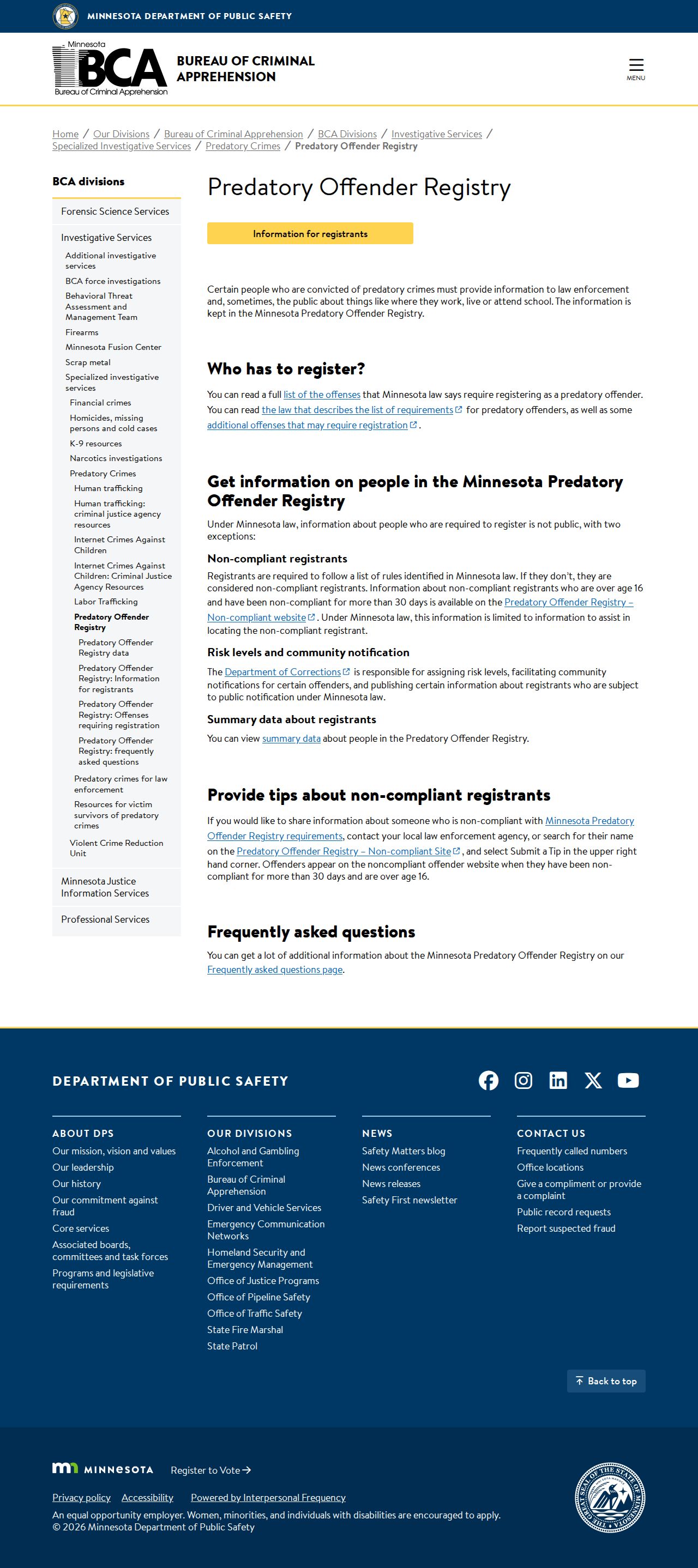
The BCA page helps prevent a public registry result or no-result from being mistaken for a complete Polk County supervision record.
The Minnesota Methamphetamine Offender Registry is also a conviction-based resource with a narrow statutory purpose. It covers specified felony convictions involving manufacture or intent to manufacture and supports a name or county search. It does not show current custody, a jail release date, parole, probation, or final discharge. Use the court order, TCCC route, and MNDOC status for those questions.
Polk County's official release-notification page separately routes local detention notices to VINE and DOC cases to Minnesota Haven. That split is more useful for custody changes than either registry.
Polk County Supervision Changes
Conditions come from the court order, release certificate, and supervising authority. Public records may show the type and term of supervision, the agency, expiration date, or later violation proceedings. They do not necessarily reveal every instruction given to one person. When a detail matters, read the signed order or request the available agency record rather than relying on a broad summary.
An alleged violation can lead to a warrant, custody, a revocation process, modified conditions, or continued supervision. Those outcomes are not interchangeable. A person may be held at NWRCC on a violation warrant while remaining within DOC or court jurisdiction. Likewise, leaving the NWRCC roster may be a transfer, not a return home. Match each event to its custodian and order.
Under Minnesota's ordinary framework for covered fixed executed felony sentences after August 1, 1993, the sentence begins with two-thirds imprisonment and one-third supervised release under Minn. Stat. § 244.101. It is not an 85-percent rule. Disciplinary confinement can delay prison exit and reduce the time left for supervised release.
Polk County Parole Hearing Records
The Minnesota Supervised Release Board is not a general parole board for every prison sentence. Its statutory work chiefly involves life sentences, older indeterminate cases, and specified juvenile long-sentence reviews. Ordinary two-thirds and one-third supervised release usually does not depend on a discretionary hearing.
The official lifer schedule page posts a current schedule, meeting notices, agendas, livestream information, and short-term access to past agendas, recordings, and approved minutes. No statewide person-name parole-results search was found. The public trail consists of those materials while posted and the written individual decision that can be requested from DOC. A decision should be described only as the record states: grant, denial, future review or date, rescission with a new date, or final discharge.
Board review may consider the community investigation, input, programming, institutional conduct, risk, criminal history, release plan, and statutory factors. Under Minn. Stat. § 244.049, the board has defined authority. The Polk link comes from the person or committing case, not from a separate county parole calendar. The Life Sentence Victim Response Coordinator is available at MNParoleInput.DOC@state.mn.us and 651-361-7100.
Eligibility varies sharply within board cases. Some life-without-release categories have no supervised-release eligibility. Other mandatory-life cases generally require a stated minimum period, while certain juvenile-at-offense long or life sentences use statutory review points. An old nonlife indeterminate offense can also fall under older parole rules. These exceptions are why a sentence and offense date must be read before interpreting a board calendar.
A grant requires the applicable board vote and is followed by a written decision. A denial can lead to a later review, and a pre-release violation can cause rescission and a new date. The board's public materials are useful for meeting context, but the written individual decision is the better evidence for one Polk County person. Approved minutes and recordings may remain online for only a limited period, so a formal DOC request may be needed after they rotate off the site.
Confirm Polk County Supervision Discharge
An expiration date is useful, but it should not be converted into a discharge claim without the controlling record. Court probation can end through an order or the completion terms shown in the case. DOC supervised release ends when MNDOC jurisdiction ends. A status of “Under Supervision” proves that prison confinement has ended while jurisdiction remains; it is not a past actual-release certificate.
For probation, open the Polk County case in MCRO and read the Register of Actions and available orders. A court record can show the sentence, probation, later violation events, and a discharge order. For DOC supervision, use the Public Viewer, then contact the named agency or DOC records route if the person no longer appears. A full discharge should be tied to an order or official agency record.
Release notifications use a separate split. Minnesota VINE covers local detention status. Minnesota Haven covers prison custody and DOC community supervision. Neither replaces the court sentence, TCCC supervision route, or final discharge record. Confirm the person's identity at every step and treat a no-result as a reason to try the next proper source.
Polk County records can show more than one active layer. A court may retain authority over probation while NWRCC records a short custody event. MNDOC can retain jurisdiction during supervised release. A later warrant can return the person to custody without erasing the prior release. Build the timeline from dated orders and agency statuses rather than choosing one screen as the whole history.