
No Polk County 72-Hour Feed
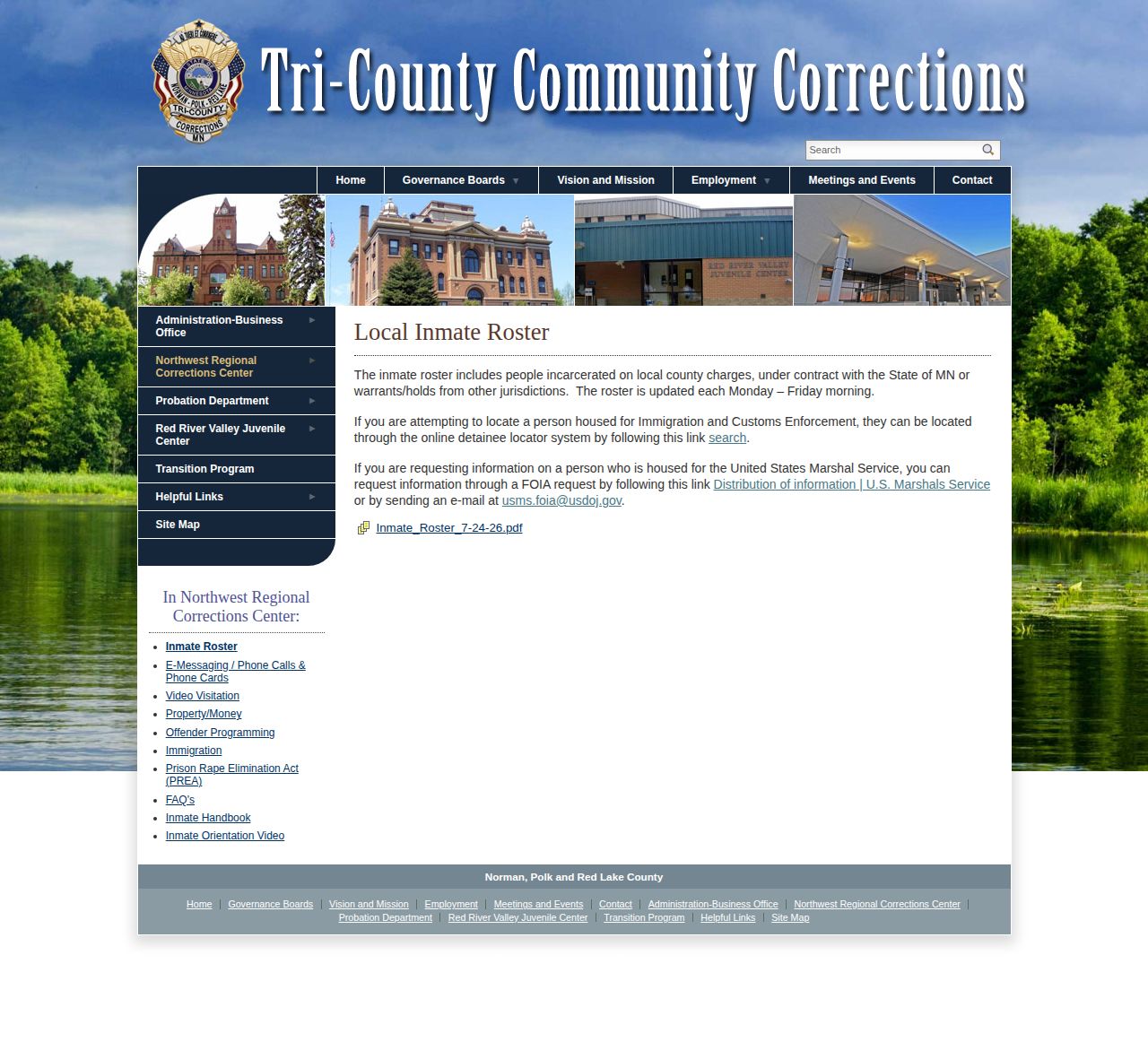
Northwest Regional Corrections Center does not publish an official rolling 72-hour release list. Tri-County Community Corrections operates NWRCC, the adult regional jail serving Polk County. Its public page links one date-stamped current-inmate PDF and says the roster is updated Monday through Friday mornings. No release tab, three-day date filter, archive, release reason, or released-name retention period was found.
The available roster answers a narrower question: who was reported in NWRCC custody at the file's data time. It does not reconstruct who left during the prior three days. A Friday PDF may remain visible through a weekend or holiday. Even when Monday's file differs, the change alone cannot identify the time, legal authority, or destination. That gap must be filled by the jail's permanent liberation record, Minnesota VINE, and the relevant Polk County court record.
The official NWRCC roster page documents the weekday update and current-custody scope.
Build a Polk County Release Timeline
A three-day review needs fixed start and end points. Write down the exact period first. Then gather events from sources that reflect different parts of the custody path. The roster can mark reported presence, VINE can flag a local custody change, the court file can explain legal authority, and TCCC can supply the lasting jail record. This approach is slower than opening a feed, but it avoids turning gaps into false release claims.
- Set the precise 72-hour range and note whether it crosses a weekend or holiday.
- Open the NWRCC landing page. Save the current PDF date and any earlier roster already lawfully retained, but do not treat either as a release list.
- Search Minnesota VINELink for the individual and review the reported local facility and custody status.
- Read the Polk County court Register of Actions for bond, dismissal, sentence, probation, time-served credit, or commitment orders entered during the period.
- Send TCCC a focused request for the NWRCC commitment and liberation record, including release authority and destination if maintained.
- Follow any transfer into MNDOC, another jail, BOP, USMS, or ICE records as the evidence directs.
A same-day event near the end of the range can also be reviewed through the Polk County 24-Hour Release List fallback process. Neither page represents a government feed. Both route the question to sources that can document the actual custody change.
Note: Save each roster's date and viewing context because a replaceable PDF does not provide a permanent public change history.
Polk County Three-Day Record Fields
There are no official Polk County 72-hour feed fields. The NWRCC landing page promises only the roster's population scope and weekday-morning cadence. It does not promise a release date, reason, archive length, photo, or three-day retention window. A written request should therefore seek the durable facts needed to place the release inside the selected period.
| Timeline field | Role in a 72-hour review |
|---|---|
| Full name and booking number | Distinguishes the correct admission from similar names or repeat bookings. |
| Admission or commitment date | Confirms that the NWRCC stay overlaps the period being checked. |
| Liberation date and time | Places the end of NWRCC custody inside or outside the three-day range. |
| Authority for liberation | Shows whether the event followed bond, court action, sentence expiration, transfer, or another authority. |
| Disposition or destination | Separates community return from movement to another custodian, if maintained. |
| Charges and holds at exit | Identifies reasons another agency may have taken custody. |
| Court case number | Connects the jail event with the Polk County order or disposition. |
Minn. Stat. § 641.05 requires the jail's permanent record to show when and by what authority a person was liberated. That language makes the record more useful than a change between temporary web rosters. Destination and other details should be requested if maintained, but they should not be promised before the agency responds.
Polk County Weekend Roster Lag
The NWRCC roster's weekday schedule is the defining three-day data quirk. A Friday morning PDF can remain the displayed file through Saturday and Sunday. If Monday is a holiday, the gap may last longer. Custody can change during that span even though the public roster does not. A Monday update is a new current snapshot, not a backfilled list of each weekend departure.
Suppose a person appears Friday but not Monday. The two files show only a change in published presence. They do not show whether the person posted bond on Friday, completed a sentence on Saturday, moved to MNDOC on Sunday, or left because another warrant was served. The same person could also re-enter custody under a new booking. Exact dates and authority require the jail record and relevant court or receiving-agency record.
A 72-hour window is still useful as an organizing period. It tells the requester what dates to name and which court entries to inspect. Yet it does not convert the weekday roster into a release archive. Minnesota VINE may supply a more timely local custody-change signal because it receives periodic facility data, while NWRCC remains the source for definitive jail documentation.
Note: No official standard release hour, weekend procedure, transport service, family waiting rule, or gate payment was verified for NWRCC.
Polk County Three-Day Source Checks
Different sources answer different questions across the same three days. The NWRCC roster checks reported local custody on a dated morning. VINE can report a local detention change and supports notifications. The Polk County court file can show the legal action behind bond, dismissal, sentencing, probation, or commitment. The permanent jail record connects the change to a time and liberation authority.
| Source | Best evidence | Key limit |
|---|---|---|
| NWRCC roster | Reported current custody on the PDF's date. | No release history or event-by-event weekend record. |
| Minnesota VINE | Recent local custody status or notification event. | Periodic feed, not the permanent release authority. |
| TCCC written response | Commitment and liberation facts held by the regional jail. | Requires a focused request and agency processing. |
| Polk court file | Orders, sentence, disposition, and probation action. | May not show the exact physical departure time. |
| Receiving locator | Status after a documented transfer. | Each locator covers only its own custody system. |
Phone contact can help route the request. NWRCC's main number is 218-470-8100, and its official facility page lists 24-hour sergeant lines at 218-470-8149 and 218-470-8150. A call does not guarantee disclosure. Use the written route when the exact liberation record is needed.
Separate Polk County Release From Transfer
“Off roster” is not a complete status. NWRCC can hold people on local charges, Minnesota contract placements, and other-jurisdiction warrants or holds. A person may leave because a court authorized community release. The same visible change can occur when MNDOC, another county, USMS, or ICE takes custody. The next search must follow the disposition rather than assume freedom.
If the jail record shows a Minnesota state commitment, use the MNDOC Public Viewer after allowing for processing lag. It covers adults committed to the Commissioner of Corrections who remain imprisoned or under DOC supervision. It is not a list of all past Polk County jail releases. A person under DOC supervision has left prison confinement but has not yet completed DOC jurisdiction.
For a federal path, the BOP locator becomes relevant once a person enters BOP custody. USMS records or the federal docket may cover earlier detention and transport. ICE's online locator chiefly checks current qualifying immigration detention and is not a past-release archive. Another county transfer calls for that county's jail source or VINE. These boundaries keep a three-day timeline accurate.
Confirm Polk County Release Records
The TCCC data-practices process is the direct written route for NWRCC jail data. Give the full name and date of birth if known, the booking or court number if available, NWRCC as the facility, and the exact 72-hour range. Ask for the commitment record, the date and time of liberation, the authority by which the person was liberated, and the release or transfer destination if maintained.
The TCCC data-practices page links its Data Request Form and Classification Schedule. TCCC says it will advise whether it holds the data, its classification, and whether the requested format is available. No fixed fee schedule or guaranteed response time is published there, so ask for an estimate.
Pair the written response with the Polk court record when legal authority needs context. A court order can explain why release or transfer was authorized, but it may not show the exact time NWRCC physically ended custody. The jail record supplies that local endpoint. If another custodian appears, confirm the next stage with that agency. The Polk County released inmate search maps those local, state, federal, and immigration paths for one named person.